 By Admin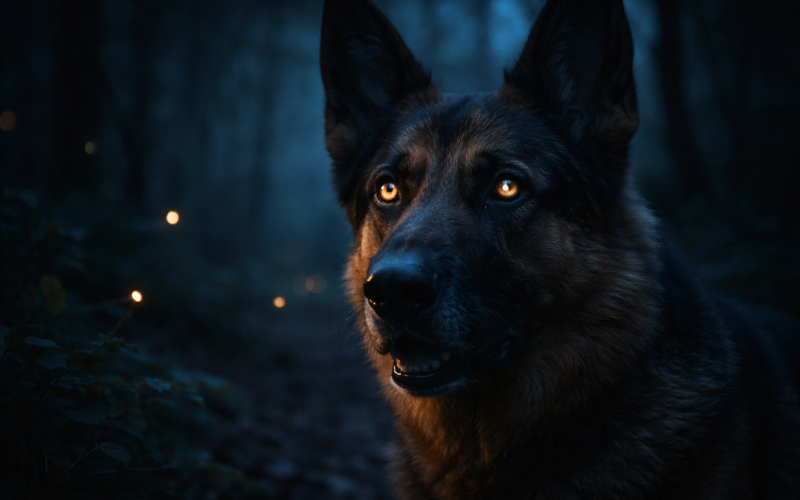
Introduction
If you’ve ever walked your dog in the evening or woken up to find them moving confidently around the house at night, you might have wondered: can dogs see in the dark? Unlike humans, dogs seem to navigate dimly lit environments with ease, sometimes startling us with their nighttime agility. Understanding how your pup’s eyes work can help you appreciate their unique vision and keep them safe during low-light situations.
Dogs have evolved to see well in conditions where humans struggle. While they don’t have superhuman night vision, certain features of their eyes give them an advantage in detecting movement and shapes when light is limited. In this article, we’ll explore how dog eyes differ from human eyes, how dogs see in darkness, the factors that affect their night vision, signs that your dog may have trouble seeing at night, and practical tips to ensure their safety after sunset.
How Dog Eyes Differ from Human Eyes
Dogs’ eyes are built differently from ours. While humans rely heavily on color and sharp detail, dogs prioritize motion detection and low-light vision. Their eyes contain more rods than cones—special cells in the retina that help detect light and movement. Rods allow dogs to see well in dim environments, while cones are responsible for color perception. This means that although dogs may not see a rainbow as vividly as humans, they are far more sensitive to low light.
Another key feature is the tapetum lucidum, a reflective layer behind the retina. This layer acts like a mirror, reflecting light that passes through the retina back into the eye. This reflection improves a dog’s ability to detect even the faintest light, giving the impression that their eyes “glow” when illuminated at night.
Night Vision: How Dogs See in Darkness
Dogs’ night vision is impressive but not limitless. While they can see in low-light conditions much better than humans, complete darkness still poses challenges. Their eyes are tuned to detect motion and changes in contrast, rather than fine details. This is why you might notice your dog quickly locating a ball or spotting a moving person in the dim light, while small objects on the floor go unnoticed.
Common nighttime behaviors—like sniffing around the house, climbing stairs, or navigating a dark yard—demonstrate their reliance on these visual advantages. Dogs combine their keen sense of smell, hearing, and night-adapted vision to move confidently, even when light is scarce.
However, it’s important to remember that dogs are not nocturnal predators. Their vision has limits, and extremely dark or visually complex environments can still pose risks.
Factors That Affect a Dog’s Night Vision
Several factors influence how well your dog can see in low light. Age plays a significant role; as dogs get older, their eyes can develop conditions like cataracts, which reduce their ability to see clearly in dim environments.
Breed differences also matter. Dogs with larger eyes, like huskies or retrievers, often have better night vision than smaller breeds. Eye shape and retina structure can affect how much light enters the eye and how it’s processed.
Environmental conditions are another consideration. Bright city lights, reflections, or shadows can either help or hinder your dog’s night vision. A cluttered yard or unfamiliar terrain may also make it harder for your dog to navigate safely after dark.
Signs Your Dog Struggles to See at Night
Even though dogs are well-adapted to low-light environments, some may experience vision difficulties. Signs to watch for include hesitation when moving through dimly lit areas, frequent bumping into objects, or a noticeable reluctance to go outside after dark.
Changes in behavior, such as anxiety during nighttime walks or confusion on familiar routes, may indicate a vision issue. If you notice these signs, it’s best to consult a veterinarian. Early detection of eye conditions can prevent further deterioration and help your dog maintain confidence in low-light situations.
Tips to Keep Your Dog Safe in Low-Light Conditions
Even dogs with excellent night vision benefit from a little extra care. When walking at night, using reflective collars or leashes can help you keep track of your pup and alert others to their presence. Well-lit paths and familiar routes reduce the risk of accidents, while night lights inside the home can help your dog move comfortably in dark hallways or staircases.
Training also plays a role. Encouraging your dog to respond reliably to commands, even in low-light conditions, helps them navigate safely. Allowing them time to explore new environments during the day can make nighttime navigation less stressful, as they can rely on memory as well as vision.
Conclusion
So, can dogs see in the dark? The answer is yes, but with some limitations. Dogs have specialized eyes designed to detect movement and shapes in low-light conditions, giving them an advantage over humans at night. Their tapetum lucidum and abundance of rods enhance their night vision, while age, breed, and environmental factors can influence how well they see.
Understanding your dog’s visual abilities can help you keep them safe and confident after dark. By observing their behavior, providing appropriate lighting, and using reflective gear when necessary, you can ensure that your furry friend navigates the night comfortably and safely.
FAQs
1. Can all dogs see equally well in the dark?
Not all dogs have the same night vision. Factors like breed, age, and eye health can cause differences in how well a dog sees in low light.
2. Do dogs rely on other senses at night?
Yes. Dogs often use their sense of smell and hearing to complement their vision, helping them navigate environments that are too dark to rely on sight alone.
3. Should I be concerned if my dog bumps into things at night?
Occasional bumps are normal, but frequent accidents or hesitation may indicate a vision problem. Consulting a veterinarian can help identify any underlying issues early.